
Afterword: After Two Bullets
If you have read this far, thank you for coming with me on this long search for civilization's roots.
This is a book written for the living, after gunfire and funerals. Before you close it, I want to tell you where construction began.
The First Gunshot
On July 13, 2024, shots rang out at a campaign rally in Butler, Pennsylvania. Presidential candidate Donald Trump was wounded. Corey Comperatore, a spectator, was killed. Two other spectators were shot and injured.1
A man went to hear a speech and never came home.
Watching that scene, I seemed to hear a sound from deep within a great structure—a sound it should not make.
A democratic society allows fierce argument. You may oppose a candidate's policies, despise his language, criticize his character, and use your vote to keep him out of office.
None of that gives anyone the right to end the argument with a bullet.
The purpose of a ballot is to let paper replace bullets. The purpose of debate is to let us disagree without destroying one another.
At that moment, I first realized that I had to write a book. Why could a country with freedom of speech and the rule of law built into its fundamental institutions still hear such gunfire? What allows the things that support a free society to endure?
But I did not break ground immediately.
I was used to reading construction drawings, calculating loads, working with concrete, steel, and soil. I kept telling myself that someone with deeper learning and a stronger command of language would step forward. Civilization was an enormous subject. It did not need another word from a builder.
I had handed the responsibility to an imaginary “better-qualified person.” I had never asked when that person would arrive. What if he was waiting too?
So I remained silent for more than a year after that.
The Second Gunshot
On September 10, 2025, Charlie Kirk was shot and killed at an event at Utah Valley University. He was only thirty-one.2
Once again, a person in the middle of speaking had his answer cut short by a bullet.
I refuse to treat such a death as something only those who shared his views should mourn.
I had to take my own words seriously: “I must write.” Between wanting to write a book and putting one in a reader's hands lay time that only I could give.
This time, I started writing.
The Last Chair
The question I was asking also arose in my own life.
In 2021, the Evergrande crisis broke. I completed the work I was responsible for and helped the company keep its promise to deliver homes to buyers. It did not keep its promise to pay me.
The work went out. The money never came back.
When someone breaks a promise to me, do I gain the privilege of breaking my promises to others?
My name was on other promises too. When the losses came, I asked my creditors for time and continued to meet my obligations. They had the same right to ask me: You promised. What will you do about it?
Being a victim did not entitle me to decide unilaterally that their waiting no longer counted as a cost. I needed to explain my difficulties honestly. I also needed to take seriously the lives they had arranged around my commitments.
I believe that keeping our word builds trust. But one person keeping his word cannot guarantee an entire chain of cooperation. Accountability and remedies still require institutions people can actually use.
The God I revere sees more than how others treat me. He sees how I treat them. I cannot use his faithfulness to make demands of someone else, then set it aside when my turn comes.
If I demand that others keep their word while using the wrong done to me as an excuse not to keep mine, I am still keeping a king's chair for myself in my heart.
That is the last chair: the exception I reserve for myself. It must be emptied too. I have a right to pursue what others owe me. They have the same right to ask about what I owe them.
Writing these words does not fulfill the promises still outstanding in my life. Those obligations must still be met, one by one, according to the terms of each.
This book began with gunfire. It cannot be completed in hatred.
First Principles Measure This Stack of Paper Too
The method in Chapter 15 came back to my own desk.
Institutions, trust, and prosperity are the results this book tries to trace to their source. Displaying those results does not explain how they grew.
First-principles thinking requires me to ask what an argument rests on, state its starting point, and inspect its reasoning. I follow the question back to what personhood itself rests on. I place the Creator postulate at the beginning, then work forward: How can an independent person freely enter a covenant, keep it when it becomes costly, and build trust with people he has never met?
The starting point must be clear. Each inference must follow. The historical evidence must stand up to questions. My enthusiasm cannot substitute for the path from roots to branches.
The five-step process brings those requirements to this stack of paper.
Step one: Question the requirements.
First ask what this book needs to answer and why each chapter needs to exist. Having read some history or fallen in love with a story does not entitle me to take the reader on a detour through it. Even a requirement I set myself must be questioned.
Step two: Delete what is unnecessary.
Time spent writing, depth of research, even a beautiful sentence cannot decide whether a passage belongs. Repeated explanations, irrelevant material, and sentences that only make the author look right must go. If a necessary step turns out to be missing, put it back. The time readers entrust to me deserves care too.
Step three: Simplify and optimize.
Only what remains deserves further refinement. I need to make the path from evidence to conclusion clear enough for readers to follow—and to see where I may have gone wrong. Rewrite a confusing metaphor. Supply a missing inference. Simplification should remove obstacles to reading, not remove the argument itself.
Step four: Accelerate the cycle.
If a quotation is doubtful, return to the original. If the evidence does not fit the judgment, examine the judgment again. Check and revise early. Do not wait until the book is beautifully typeset to face a problem in a load-bearing part. Correcting an error sooner means less distance traveled in the wrong direction.
Step five: Automate.
Only now should settled, repetitive work—the table of contents, note numbers, page numbers, cross-references—be handed over to tools. I must still answer whether a quotation preserves its original meaning, whether the evidence supports the judgment, and whether a conclusion exceeds its grounds.
The order cannot be reversed. Writing can make this mistake too: polishing a passage over and over, only to discover that it should never have remained. Unless I first ask whether it is needed, all I gain from speed and automation is a faster route to a version that needs reworking.
First-principles thinking runs through all five steps. Every check, cut, and rewrite may send me back to my original judgment. Thought enters action. Action corrects thought. The writing changes in response to inspection.
That is the unity of thought and action I have practiced in writing this book. First principles and the five-step process are how I think and carry out the work. The sixty-second test—“I disagree” and “I gave my word”—is the framework this book proposes for inspecting a civilization. The laws of physics do not change with the name of the rocket builder. Nor can this measuring stick change to suit the person or country being measured. It measures me and this book too.
After the book leaves my hands, readers still have the right to ask: What is your evidence? Does this step follow logically?
This book is my promise kept. The stack of paper in your hands is the work I have delivered. My good intentions cannot answer for it.
The pages end here.
Please do not let a bullet have the last word.
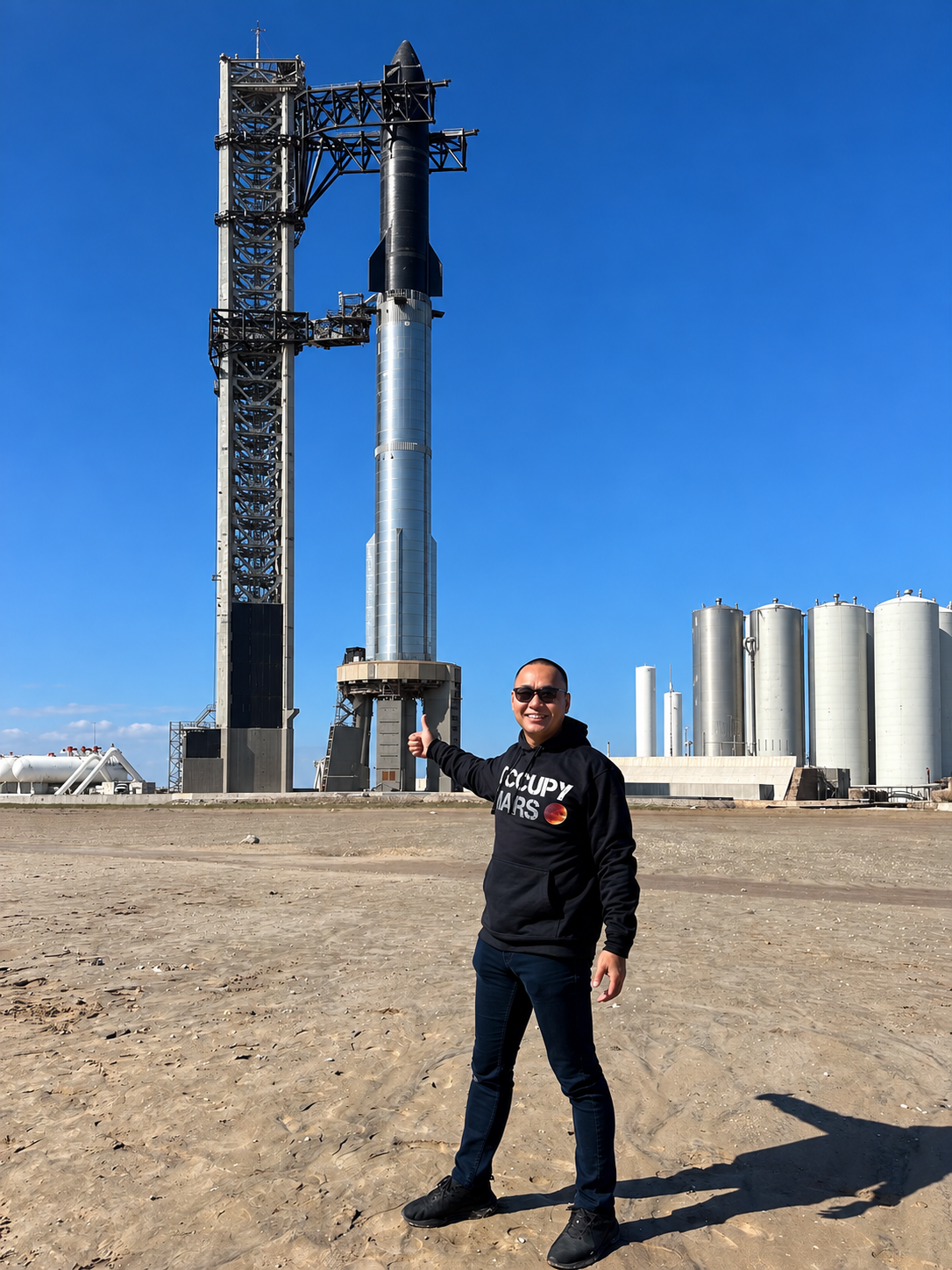
Titus Howe at Starbase, November 2023
Notes & sources
1. Federal Bureau of Investigation, “Update on the FBI Investigation of the Attempted Assassination of Former President Donald Trump,” July 2024; Pennsylvania State Police, “Pennsylvania State Police Identify Victims Shot During Attempted Assassination of Former President Trump,” July 14, 2024, identifying Corey Comperatore, who was killed, and the two injured spectators.
2. Federal Bureau of Investigation, “Utah Valley Shooting Updates,” September 2025; Associated Press reporting on Kirk's killing, September 10, 2025.
End of this section